Innovations in Space Technology
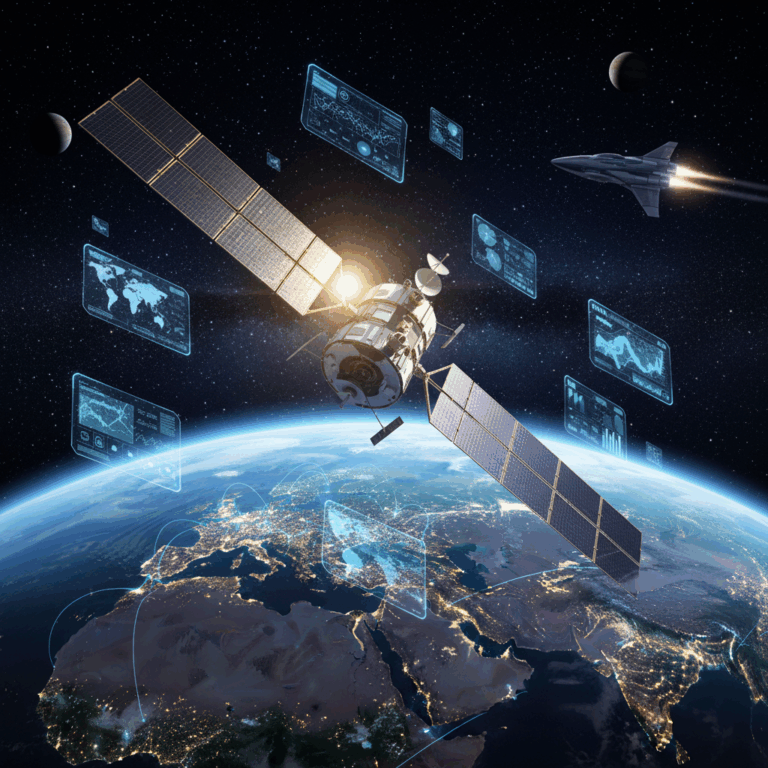
The field of space technology has rapidly evolved through groundbreaking innovations, transforming how we explore and utilize space. Integration of cutting-edge technologies is making space missions more efficient and autonomous.
Key advancements include the use of artificial intelligence and machine learning, enabling real-time data analysis and autonomous decision-making. Meanwhile, rocket technology has progressed with reusable launch vehicles that reduce costs and increase mission frequency.
Integration of Artificial Intelligence and Machine Learning
Artificial intelligence (AI) and machine learning have become essential in modern space systems. They enhance mission control by processing vast data, allowing for swift, informed decisions without human delay.
These technologies facilitate autonomous operations in spacecraft, improving navigation, system monitoring, and anomaly detection. AI-driven digital twins analyze live environmental data for accurate Earth observation and weather prediction.
By automating complex processes, AI reduces risks and operational costs, enabling missions to adapt dynamically to changing conditions in space. This integration marks a significant leap in space exploration capabilities.
Development of Reusable Launch Vehicles
Reusable launch vehicles represent a revolutionary shift in rocket technology, allowing components to be recovered and reused for multiple flights. This innovation drastically cuts launch costs and environmental impact.
Programs like Blue Origin’s New Glenn illustrate how reusability supports more frequent and ambitious space missions. Efficient launch systems help stimulate commercial and scientific space activities by increasing access to orbit.
By refining propulsion and recovery techniques, reusable launchers enhance reliability and turnaround time, fostering a sustainable space industry geared for future exploration challenges.
Satellite Advancements and Constellations
The satellite industry has seen remarkable progress, with miniaturization enabling the rise of small satellites that perform complex tasks at reduced cost. These compact satellites revolutionize communication and Earth monitoring.
Mega-constellations of small satellites are being deployed worldwide to provide comprehensive, low-latency internet coverage. This global reach is driven by innovations in encryption and collision avoidance, ensuring safe and secure operation.
Rise of Small Satellites and Miniaturization
Small satellites, often weighing less than 500 kilograms, have transformed space operations, providing cost-effective solutions for communication and observation. Advances in 3D printing and materials science make these satellites lighter and more capable.
These miniaturized satellites reduce launch expenses and enable more frequent deployments, allowing companies to maintain updated, flexible constellations. Their compact size does not diminish their ability to deliver high-quality data.
Overall, the small satellite revolution supports expanded space access and fosters innovation, empowering services such as global broadband, environmental monitoring, and scientific research.
Deployment of Mega-Constellations for Global Coverage
Companies like SpaceX, OneWeb, and Amazon’s Kuiper are launching thousands of small satellites forming mega-constellations that ensure continuous global internet connectivity. This infrastructure targets underserved and remote regions.
Mega-constellations improve network resilience and reduce latency by placing satellites in low Earth orbit. Their scale demands advanced coordination technologies to manage orbital traffic and maintain system integrity.
These massive networks promise to bridge the digital divide, enhance disaster response, and enable new applications requiring stable worldwide connections, transforming global communications.
Quantum Encryption and Collision Avoidance Technologies
Advanced security measures like quantum encryption protect satellite communications from interception, ensuring data privacy in increasingly congested orbits. This represents a leap forward in safeguarding information.
Collision avoidance technologies utilize sensors and AI to detect and predict potential satellite collisions, enabling automated maneuvers that preserve valuable assets and maintain network functionality.
Interesting Fact
Quantum key distribution via satellites is becoming a practical method for ultra-secure communication, potentially revolutionizing cybersecurity in space and terrestrial networks alike.
Manufacturing and Robotics in Space
Manufacturing in space is revolutionizing production by exploiting the unique conditions of microgravity, enabling novel materials and processes not possible on Earth. This opens new frontiers for industry and science.
Robotics and autonomous systems are integral to current and future exploration missions, performing complex tasks with high precision. Their development enhances mission safety, longevity, and effectiveness in harsh environments.
Together, innovations in manufacturing and robotics are shaping a sustainable space economy and enabling extended human and robotic presence beyond Earth.
Microgravity Manufacturing and Material Innovation
Microgravity allows the creation of superior materials such as ZBLAN optical fibers, which offer significantly lower signal loss than Earth-made equivalents. This boosts communication technologies.
Pharmaceutical research benefits from the microgravity environment, where drug crystallization improves purity and efficacy. These advances accelerate the development of better medicines for Earth and space use.
Looking ahead, autonomous manufacturing with 3D printing in orbit promises to build critical infrastructure and even biological products like organs, reducing dependence on Earth-based supply chains.
Robotics and Autonomous Systems for Exploration
Robotic systems perform vital functions including planetary surface exploration, in-orbit servicing, and maintenance, extending mission durations and reducing human risk and cost.
Autonomy in robotics allows real-time decision-making and adaptability in unpredictable space conditions, vital for remote operations where human control is limited by communication delays.
These systems pave the way for advanced missions, enabling detailed scientific study and the construction of infrastructure for future human settlements on the Moon, Mars, and beyond.
Ongoing and Future Space Missions
Ongoing and planned space missions in the near future focus on expanding scientific knowledge and enhancing technology applications. These missions aim to explore planetary environments and the cosmos with improved precision.
With innovations in propulsion, AI, and satellite technologies, upcoming missions pursue ambitious goals like mapping the universe, studying planetary magnetospheres, and advancing robotic exploration capabilities to deepen our understanding of space.
Scientific Objectives of Upcoming Missions
Future space missions target critical scientific challenges such as studying planetary atmospheres, cosmic phenomena, and magnetic fields. For example, NASA’s SPHEREx mission will map the sky in infrared to investigate asteroid compositions and cosmic origins.
Mars exploration missions are set to analyze its magnetosphere and surface conditions, providing insights into planetary evolution and habitability. These data contribute to our knowledge of both Mars and Earth’s environment.
The incorporation of autonomous systems and AI in these missions supports complex scientific activities by enabling adaptive decision-making and more detailed data collection in remote or harsh environments.
Impact on Communication, Environmental Monitoring, and Economy
Space missions directly enhance global communication infrastructure by deploying advanced satellites that increase internet access and connectivity worldwide, overcoming traditional barriers of geography.
Environmental monitoring benefits from continuous satellite data that track climate change effects, natural disasters, and resource management, enabling timely responses and better policy decisions.
Economically, these missions stimulate innovation-driven growth, creating jobs and commercial opportunities in space technology, manufacturing, and service sectors, reinforcing the expanding global space economy.