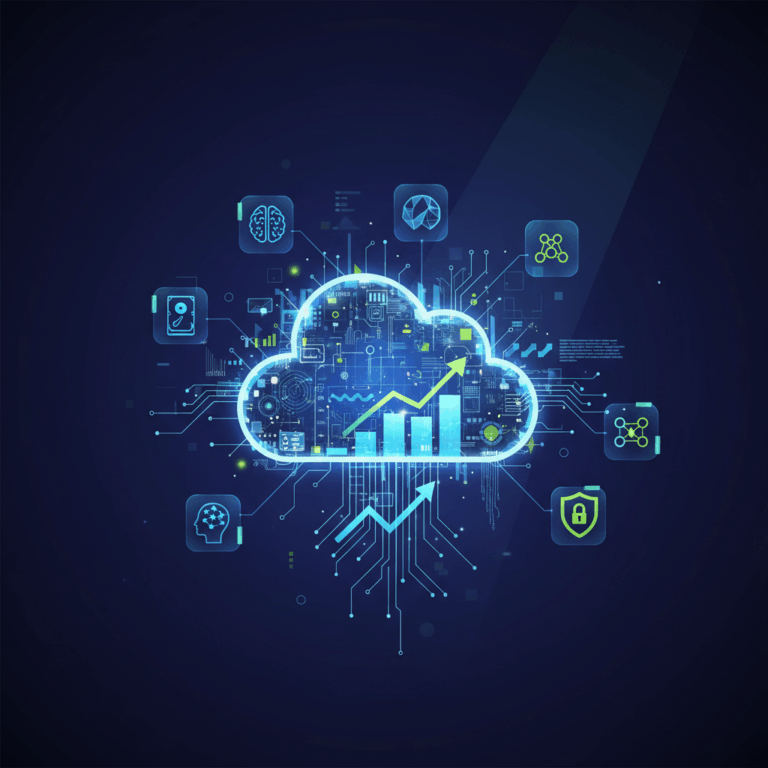
Cloud-Native Technologies and AI Integration
The rise of cloud-native technologies is transforming application development by enabling faster, scalable, and resilient digital workloads. Organizations increasingly rely on microservices and containerization to build modern applications.
Alongside this shift, AI and machine learning have become integral to cloud platforms, driving automation, improved decision-making, and enhanced data insights. These trends redefine how businesses innovate and operate in the cloud.
Adoption of Cloud-Native Architectures
Cloud-native architecture has become the foundation for most new digital workloads, surpassing 95% adoption in deployments. This approach leverages microservices, containers, and orchestration tools such as Kubernetes for improved agility.
By embracing cloud-native designs, companies achieve greater scalability and resilience. This reduces time-to-market and supports continuous integration and deployment, making it easier to respond dynamically to changing business needs.
Containers and tools like Docker simplify application portability across environments. This flexibility fosters innovation while minimizing infrastructure constraints commonly seen in traditional monolithic systems.
Embedding AI and Machine Learning in Cloud Platforms
Artificial intelligence and machine learning capabilities are now embedded directly within cloud platforms, allowing organizations to automate tasks and extract actionable insights from large datasets efficiently.
The integration of AI-driven services facilitates enhanced operational efficiency by enabling predictive analytics, intelligent automation, and real-time decision-making within cloud environments.
Emerging technologies like retrieval-augmented generation (RAG) combine large language models with live data retrieval. This improves generative AI’s accuracy, addressing reliability concerns previously seen in AI outputs.
Strengthening Generative AI Reliability
RAG services enhance generative AI by integrating local data sources with massive pre-trained models. This reduces hallucinations and improves output relevancy, making AI results more trustworthy for businesses.
Multi-Cloud, Hybrid Strategies, and Edge Computing
Organizations are increasingly adopting multi-cloud and hybrid cloud strategies to optimize flexibility, reduce vendor lock-in, and enhance resilience. This approach ensures they use the best services across platforms.
At the same time, there is a resurgence in private cloud interest, driven by data sovereignty, security, and cost concerns. Additionally, edge computing is growing rapidly to support real-time IoT data processing.
Trends in Multi-Cloud and Hybrid Cloud Use
Multi-cloud strategies enable organizations to distribute workloads across multiple providers, minimizing risk and optimizing performance based on workload needs. They also help avoid dependency on a single vendor.
Hybrid cloud, combining public and private clouds, allows businesses to keep sensitive data on-premises while leveraging cloud resources for scalability, balancing control with agility effectively.
Tools for managing complex multi-cloud environments are evolving, simplifying deployment and monitoring across platforms. This trend helps companies navigate the challenges of hybrid cloud architectures.
Renewed Interest in Private Cloud Solutions
The emphasis on data security and sovereignty has renewed organizations’ focus on private clouds. This enables tighter control over sensitive information and compliance with regulations.
Alternatives to traditional private cloud technologies like VMware are gaining popularity, driven by the need for cost-effective and flexible solutions tailored to enterprise requirements.
Private clouds continue to evolve with better automation and integration capabilities, making them attractive for workloads that require strict control or enhanced security features.
Growth of Edge Computing and IoT Data Processing
Edge computing is expanding to process data nearer to where it’s generated, reducing latency and bandwidth usage. This is critical for applications requiring real-time analytics, such as healthcare and manufacturing.
The explosive growth of IoT devices generates massive volumes of data, necessitating distributed processing at the edge to ensure timely insights and action without heavy cloud dependency.
Edge and cloud integration allows seamless data flow and workload distribution, combining the advantages of centralized computing with localized processing to enhance reliability and performance.
Security Enhancements in Cloud Computing
Security continues to be a critical focus as cloud adoption grows. Organizations are adopting advanced security posture management tools to strengthen cloud defenses against evolving threats.
AI-powered threat detection methodologies are becoming essential, helping to identify and mitigate risks in real time. These innovations enhance cloud security beyond traditional measures.
Advanced Cloud Security Posture and Threat Detection
Cloud security posture management (CSPM) tools automate the detection of misconfigurations and compliance lapses, enabling proactive protection across cloud environments. This minimizes vulnerabilities before exploitation.
AI and machine learning enhance threat detection by continuously analyzing patterns and anomalous behaviors. This approach identifies zero-day exploits and sophisticated attacks faster than manual methods.
Integration of infrastructure-as-code (IaC) scanning helps ensure security best practices are embedded early in the development pipeline, preventing risks before deployment in cloud infrastructures.
Specialized Security Platforms vs. Native Solutions
While hyperscalers offer native security solutions integrated within their platforms, specialized security providers offer deeper, more comprehensive protections tailored to complex enterprise needs.
Specialized platforms often deliver advanced analytics, greater visibility, and cross-cloud protections that may exceed the scope of native tools, appealing to organizations with multi-cloud and hybrid environments.
Choosing between native and third-party security depends on factors like organizational complexity, compliance requirements, and desired control levels over policy enforcement and incident response.
Emerging Cloud Technologies and Development Trends
Emerging cloud technologies like Quantum Computing as a Service (QaaS) and low-code/no-code platforms are driving innovation and accessibility in cloud development. These advancements open new frontiers for businesses and developers.
By making powerful computing resources and simplified development tools widely available, these trends lower barriers and enable rapid creation of applications, fueling growth and digital transformation in various industries.
Quantum Computing as a Service (QaaS)
Quantum Computing as a Service offers cloud access to quantum processors, allowing organizations to experiment with quantum algorithms without owning specialized hardware. This democratizes quantum research and application.
QaaS providers deliver scalable quantum resources via the cloud, accelerating innovation in fields like finance, healthcare, and materials science by solving complex problems beyond classical computing capabilities.
Through cloud integration, quantum computing becomes more accessible for experimentation, helping enterprises explore optimization, cryptography, and simulation use cases with lower entry costs.
Impact of Low-Code and No-Code Platforms
Low-code and no-code platforms are transforming cloud development by enabling users with limited coding skills to create applications quickly. This accelerates innovation and reduces reliance on professional developers.
These platforms offer visual interfaces and pre-built components, fostering collaboration between technical and non-technical teams, and shortening development cycles for business solutions.
As these tools mature, they empower organizations to respond faster to changing needs, streamline workflows, and democratize app creation across departments.