5G in Smart Cities and Energy
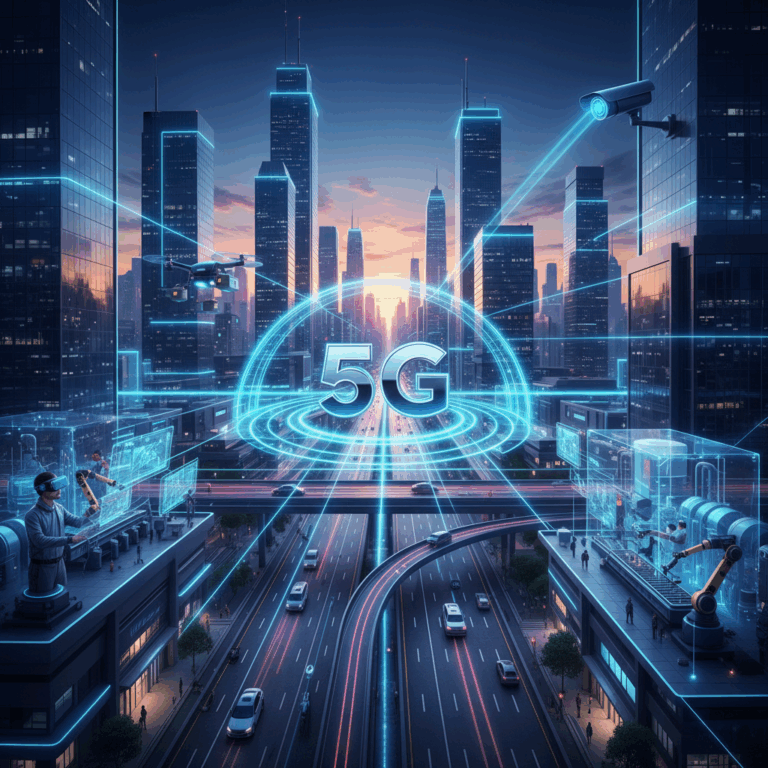
5G technology is transforming smart cities by enabling real-time data exchange through vast networks of interconnected devices. This connectivity supports critical improvements, such as traffic management and energy efficiency.
Its low latency and high-speed capabilities allow cities to implement intelligent systems that adapt quickly to changing conditions. As a result, urban environments become more sustainable, efficient, and responsive to residents’ needs.
Real-time traffic monitoring and management
With 5G, cities can deploy advanced sensor networks that monitor traffic flow continuously. These sensors collect data on vehicle movements, congestion patterns, and accident occurrences to improve road safety and reduce delays.
This data powers smart traffic lights that adjust their timing dynamically, optimizing traffic flow and minimizing idle time. The result is a decrease in congestion, leading to smoother commutes and reduced emissions throughout urban areas.
Additionally, emergency response services benefit by receiving instantaneous alerts about accidents or hazards, allowing faster and more coordinated intervention efforts to protect lives and property.
Smart energy grids and efficient consumption
5G enables the creation of smart energy grids that use real-time data to balance electricity supply and demand efficiently. These grids leverage artificial intelligence and automation to reduce wastage and promote sustainable energy use.
By monitoring consumption patterns closely, utilities can adjust energy distribution dynamically, integrating renewable sources smoothly and enhancing grid reliability. Consumers also gain control through smart meters, helping them reduce costs and carbon footprints.
This efficient energy management leads to lower emissions and supports the development of cleaner, greener cities, aligning with global sustainability goals.
Healthcare Innovations Enabled by 5G
5G technology is revolutionizing healthcare by enabling faster and more reliable communication between devices and medical professionals. This advancement supports innovative medical procedures and real-time patient monitoring outside traditional settings.
With its ultra-low latency and high bandwidth, 5G facilitates new possibilities for remote care, early diagnosis, and urgent responses. Patients benefit from quicker interventions and personalized health management that improve overall outcomes.
Remote surgery and robotic assistance
5G’s ultra-responsive connectivity enables surgeons to perform remote surgeries using robotic instruments controlled in real-time. This capability opens access to expert care regardless of patient location, reducing travel barriers and delays.
Robotic assistance powered by 5G allows precise movements with minimal latency, ensuring safer procedures. It also supports telesurgery collaborations, where specialists guide less experienced surgeons during complex operations.
These advances decrease risks and improve recovery times by allowing minimally invasive techniques to be applied promptly, even in remote or underserved areas.
Wearable health monitoring devices
Wearables connected via 5G continuously collect vital health data such as heart rate, blood oxygen, and activity levels. This real-time monitoring allows early detection of abnormalities and timely medical intervention.
Enhanced connectivity ensures data is transmitted instantly to healthcare providers, enabling personalized treatment plans and improved chronic disease management. Patients gain peace of mind with constant oversight.
Moreover, 5G supports more sophisticated and energy-efficient devices, expanding their capabilities and reliability for everyday use.
Emergency response with connected ambulances
Ambulances equipped with 5G can transmit live video feeds and critical patient information directly to hospital teams en route. This real-time communication improves hospital preparedness and speeds up emergency treatment decisions.
Connected ambulances also coordinate seamlessly with traffic systems, allowing priority route adjustments to reduce response times. Enhanced situational awareness benefits paramedics and patients alike.
The integration of 5G in emergency services leads to more effective care delivery during critical moments, ultimately saving lives and improving recovery chances.
Transportation and Logistics Enhancements
5G technology dramatically enhances transportation and logistics by enabling seamless communication between vehicles, infrastructure, and supply systems. This connectivity improves safety, efficiency, and real-time decision-making.
By supporting ultra-low latency and high data throughput, 5G facilitates innovations like autonomous vehicle navigation and precise asset tracking. These capabilities transform how goods and people move in modern societies.
Vehicle-to-everything communication
Vehicle-to-everything (V2X) communication uses 5G networks to connect cars with traffic signals, pedestrians, and other vehicles. This real-time data sharing helps prevent accidents and reduces traffic congestion.
V2X allows vehicles to anticipate hazards and adjust driving behavior instantly, enhancing road safety. It also supports smoother traffic flow by synchronizing movements with city infrastructure.
By integrating various transportation elements, 5G-enabled V2X fosters smarter, more responsive urban mobility systems that adapt dynamically to changing conditions.
Autonomous vehicle navigation
5G’s rapid data transmission supports autonomous vehicles by processing sensor information swiftly and enabling precise, real-time navigation decisions. This reduces reaction times and improves safety on the roads.
Autonomous cars rely on 5G to communicate with nearby objects and infrastructure, ensuring accurate situational awareness. This connectivity helps vehicles handle complex environments and unexpected obstacles.
The high reliability of 5G networks allows autonomous systems to operate continuously with minimal delays, advancing self-driving technologies toward widespread adoption.
Asset tracking in supply chains
5G enables highly accurate and real-time asset tracking across supply chains, providing continuous visibility of shipment locations and conditions. This reduces losses and delays significantly.
Enhanced connectivity helps monitor perishable goods, ensuring sensitive items maintain quality during transit. It also optimizes inventory management by improving demand forecasting and logistics planning.
Impact on logistics performance
Real-time tracking supported by 5G enhances delivery precision and responsiveness, reducing transportation costs. Companies can quickly detect and resolve issues, increasing customer satisfaction.
This technology also enables predictive maintenance and route optimization, which decrease downtime and improve overall supply chain resilience and efficiency.
Industrial and Consumer Applications
5G technology is reshaping industrial and consumer sectors by enabling advanced automation and creating immersive digital experiences. Its high speed and low latency foster innovative applications that enhance productivity and engagement.
From manufacturing floors to retail spaces, 5G supports seamless connectivity and real-time interaction, driving efficiency in operations and offering consumers new ways to experience products and entertainment.
Automation and augmented reality in manufacturing
In manufacturing, 5G enables real-time communication between machines and automated systems, boosting production efficiency and reducing downtime. This connectivity supports precision operations and faster decision-making.
Augmented reality (AR) applications benefit from 5G by delivering instant data overlays to technicians during equipment maintenance or assembly. AR enhances training and troubleshooting with interactive, hands-on guidance.
These technologies together reduce errors, speed up processes, and improve safety, leading to smarter factories capable of adapting quickly to changing demands.
Immersive retail and entertainment experiences
5G transforms retail and entertainment by powering immersive virtual and augmented reality experiences. Consumers enjoy interactive environments that blend digital content seamlessly with the physical world.
In retail, 5G allows for virtual try-ons, personalized recommendations, and enhanced customer engagement. Entertainment sectors use it to deliver high-quality streaming, real-time multiplayer gaming, and augmented events.
This new level of interactivity deepens consumer involvement, boosts satisfaction, and creates innovative opportunities for brands to connect with their audiences.