Benefits of VR in Education
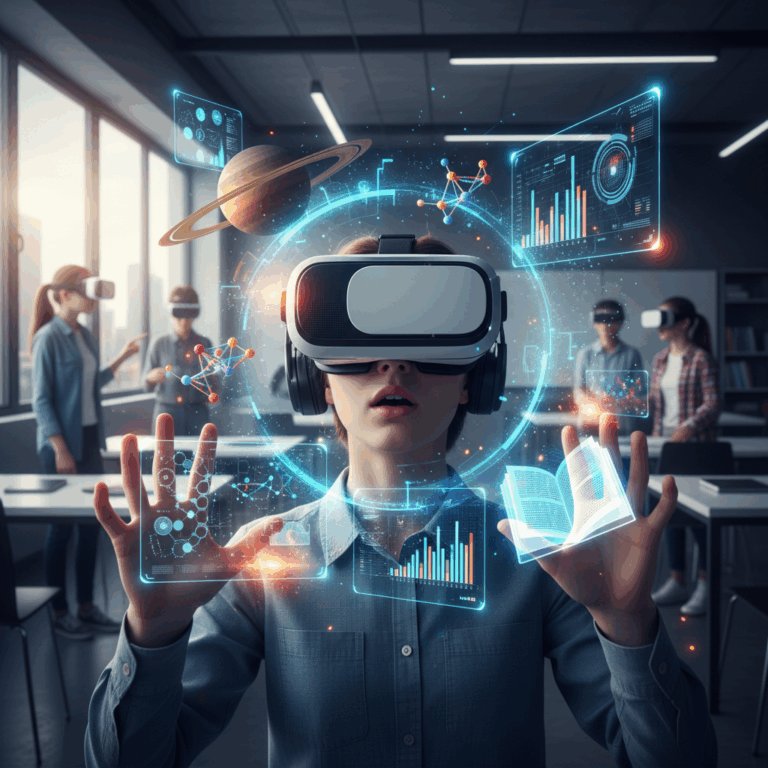
Virtual reality offers immersive and interactive learning experiences that break the limits of traditional classrooms. It engages students by placing them inside vivid educational scenarios.
By using VR, learners actively participate in lessons, which makes education more memorable and exciting. This innovation allows exploration of topics in ways not possible before.
Immersive and Interactive Learning Experiences
VR immerses students in realistic environments where they can explore historical events or scientific phenomena firsthand. This deep engagement boosts curiosity and understanding.
The interactivity of VR means students are not passive observers but active participants, enhancing knowledge retention and making abstract concepts easier to grasp.
In addition, VR’s multi-sensory approach aids different learning styles by combining visual, auditory, and kinesthetic elements into one cohesive experience.
Hands-On Practice in Simulated Environments
VR provides safe, hands-on practice opportunities that would otherwise be too risky or expensive to replicate, such as surgery or machinery operation. This helps build real-world skills confidently.
These simulated environments allow repeated practice and immediate feedback, enabling students to refine techniques and fully understand complex processes without fear of failure.
Students benefit from immersive experiments across fields, from exploring the human body to engineering systems, enhancing both comprehension and motivation to learn more.
Impact on Academic Performance
Virtual reality significantly enhances academic outcomes by providing engaging, hands-on learning tools. Studies reveal students experience noticeable improvements in test scores using VR.
This technology is especially impactful in challenging subjects, offering interactive experiences that deepen understanding and increase knowledge retention.
Improvement in Test Scores
Research shows students using VR technology in lessons often boost their test scores by up to 20% compared to traditional learning methods. This rise highlights VR’s effectiveness.
The immersive nature of VR keeps students focused and motivated, leading to better grasp of topics and improved performance in assessments across diverse subjects.
Moreover, VR’s ability to simulate real-world scenarios enables learners to apply concepts practically, which strengthens memory and recall during tests.
Effectiveness in STEM Education
VR plays a crucial role in STEM education by providing practical, experiential learning opportunities in subjects like science, technology, engineering, and math.
Interactive simulations help students visualize complex theories and conduct experiments virtually, which deepens comprehension of abstract STEM concepts.
Hands-on VR experiences enhance critical thinking and problem-solving skills, essential for success in STEM fields where experimentation and iteration matter.
Gender Gap Reduction in STEM
Virtual reality has been found to support female learners particularly well, boosting their STEM test scores significantly and closing traditional gender gaps.
By creating inclusive and engaging environments, VR encourages more girls to pursue STEM subjects with confidence and enthusiasm.
Encouraging Diversity through VR
VR breaks down stereotypes by allowing all students to explore STEM fields equally, thus fostering diversity and reducing barriers in education and career pathways.
Development of Soft Skills through VR
Virtual reality is not only effective for academic learning but also excels in developing crucial soft skills. These skills, like communication and empathy, are essential for personal and professional success.
VR enables learners to engage in realistic social scenarios where they can practice and refine these interpersonal skills in a safe, controlled environment, free from real-world pressures.
Communication, Empathy, and Teamwork Practice
VR platforms allow students to practice communication by simulating public speaking, negotiations, or interviews, building confidence and clarity in their expression.
Empathy is enhanced as learners experience diverse perspectives through immersive storytelling, fostering deeper emotional understanding and social awareness.
Teamwork skills develop as students collaborate in virtual environments, navigating challenges and solving problems together, which replicates real-life group dynamics.
VR Accessibility and Future of Education
Virtual reality is expanding accessibility in education by offering equal learning opportunities regardless of location or ability. It bridges gaps that traditional classrooms cannot.
As VR technology becomes more affordable and widespread, it is positioned to revolutionize how education is delivered, making learning more inclusive and personalized.
Inclusivity and Equal Learning Opportunities
VR enables students with disabilities or those in remote areas to participate fully in lessons through adaptable virtual environments tailored to their needs. This fosters equity in education.
By removing physical and logistical barriers, VR offers a platform where diverse learners can access quality instruction, promoting equal opportunities for academic success and skill development.
Moreover, VR environments support various learning styles and paces, ensuring each student can engage meaningfully with content, regardless of individual challenges.
Enhancing Traditional Teaching Methods
Rather than replacing educators, VR complements traditional methods by adding interactive, stimulating experiences that enhance understanding and retention of information.
Teachers can integrate VR into their curricula to provide practical simulations and immersive lessons that make complex subjects easier to grasp and more engaging.
With VR, students can explore abstract or dangerous concepts safely, deepening their comprehension and interest, while educators receive tools for personalized and adaptive instruction.