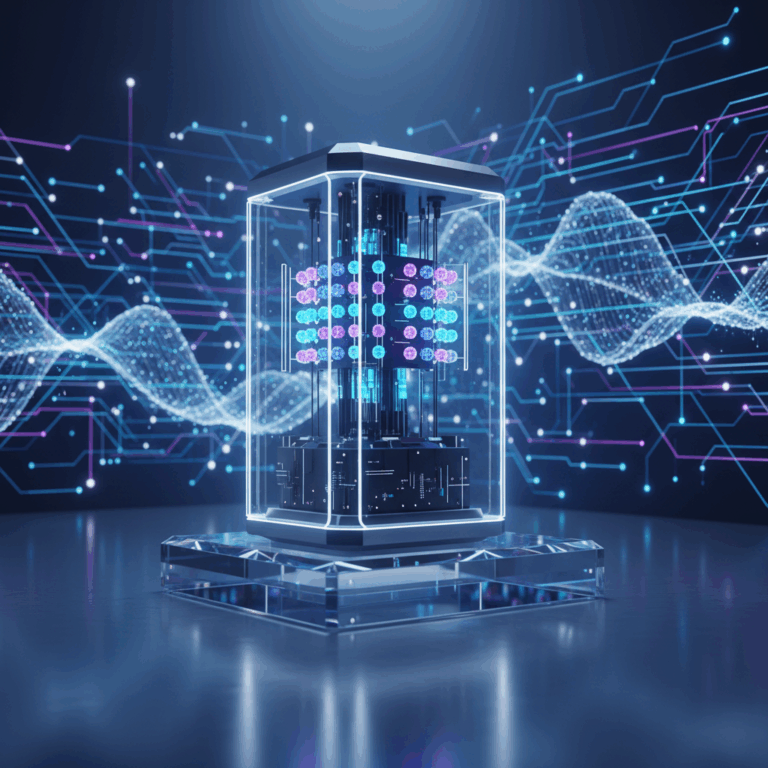
Fundamentals of Quantum Computing
Quantum computing is based on the principles of quantum mechanics, which enable a new way of processing information. It uses unique quantum properties unlike classical bits.
By leveraging superposition and entanglement, quantum computers perform computations that are impossible or highly inefficient on traditional systems. This creates vast new opportunities.
Understanding the fundamental elements like qubits and quantum gates is crucial to grasp how quantum computers achieve their power and speed in solving complex problems.
Qubits and Superposition
A qubit is the quantum version of a classical bit but can exist in multiple states simultaneously due to superposition. This means it can represent both 0 and 1 at the same time.
Superposition allows quantum computers to store and process an exponential combination of states, vastly increasing their computational capacity with each additional qubit.
This property enables the parallel evaluation of many possibilities simultaneously, which is the foundation of quantum speedup in certain algorithms.
Entanglement and Quantum Gates
Entanglement creates strong correlations between qubits so their states become interdependent, even when separated by distance. This linkage enhances coordinated quantum operations.
Quantum gates manipulate qubits through controlled operations that harness superposition and entanglement. These gates form the building blocks of quantum algorithms.
Unlike classical logic gates, quantum gates can perform complex transformations on qubit states, enabling sophisticated computational processes beyond classical capability.
Interesting Insight on Quantum Gates
Quantum gates are reversible, meaning they can return qubits to previous states without information loss, a feature absent from many classical gates and key to quantum efficiency.
Advantages Over Classical Computing
Quantum computing offers transformative advantages by leveraging qubits’ unique ability to represent multiple states simultaneously. This allows for processing vast information exponentially faster than classical computers.
Unlike classical bits limited to 0 or 1, qubits utilize quantum phenomena like superposition and entanglement, enabling powerful parallelism and new computational capabilities impossible with traditional systems.
These advantages open possibilities for solving complex problems much more efficiently, taking computing beyond the limits of classical architectures and enabling breakthroughs across many fields.
Exponential Information Processing
Quantum computers process information exponentially by representing multiple combinations of 0s and 1s simultaneously with qubits. Each added qubit doubles the computational space available.
This exponential scaling means quantum systems can explore many solutions all at once, vastly improving speed for certain calculations compared to sequential classical processing.
As a result, quantum devices can handle problems involving enormous data configurations more efficiently, using fewer resources and less time than classical counterparts.
Applications in Problem Solving
Quantum computing excels at tasks like simulating quantum systems, optimizing complex scenarios, and factoring large numbers, which are extremely challenging for classical computers.
Such capabilities enable advancements in drug discovery by modeling molecules precisely, enhance cryptography through complex key analysis, and improve optimization in logistics and AI.
This ability to quickly address currently intractable problems heralds new opportunities in science and technology, potentially transforming many research and industrial fields.
Impact on Various Industries
Various industries stand to benefit profoundly from quantum computing’s power, including pharmaceuticals, finance, energy, and artificial intelligence, where faster, more accurate computations are critical.
For example, quantum-enhanced simulations can accelerate materials discovery, while optimized algorithms improve financial modeling and risk assessment with higher precision.
As quantum technology matures, it promises to disrupt traditional processes, create new market dynamics, and unlock innovation pathways previously thought impossible.
Current Challenges in Quantum Technology
Quantum computing faces significant hurdles that limit its widespread application and scalability. These challenges are primarily centered around maintaining qubit coherence and reducing errors.
Qubit instability and interactions with the external environment cause decoherence, which disrupts quantum states and undermines computation reliability. Overcoming this is crucial for practical machines.
Researchers continue exploring methods to enhance qubit stability, error correction techniques, and hardware improvements to enable robust quantum processing in the near future.
Qubit Instability and Decoherence
Qubits are highly sensitive to external influences such as electromagnetic noise and temperature fluctuations. This leads to instability, making it difficult to maintain their quantum states.
Decoherence refers to the loss of quantum coherence, where qubits lose their superposition and entanglement properties due to interaction with the environment, causing errors in computation.
These instability issues limit the time during which quantum computations can be reliably performed, known as coherence time, which remains a major bottleneck for developing functional quantum computers.
Advancements in qubit design, including error-correcting codes and improving materials, aim to extend coherence times and reduce error rates, pushing the technology closer to practical use.
Future Prospects and Industry Impact
The future of quantum computing is promising, driven by continuous innovation and investment in research. These efforts aim to overcome existing technical hurdles.
As quantum devices improve in stability and scale, they will enable new applications that have the potential to revolutionize industries across the globe.
Understanding the trajectory of this technology helps businesses and researchers prepare for its transformative effects on computing and problem-solving capabilities.
Ongoing Research and Development
Research in quantum computing focuses on enhancing qubit coherence times, error correction methods, and scalable architectures. These advances are key to practical quantum machines.
Leading companies, startups, and academic institutions are collaborating worldwide, pushing the boundaries of quantum hardware and software development rapidly.
Significant progress in quantum algorithms and fault-tolerant designs is also helping bring more reliable and powerful quantum systems closer to reality.
Efforts to integrate quantum technology with classical computing infrastructures aim to create hybrid solutions that maximize the strengths of both paradigms.
Potential Transformations Across Sectors
Quantum computing is poised to transform sectors such as healthcare, finance, energy, and cybersecurity through enhanced data analysis and problem-solving power.
In healthcare, it could accelerate drug discovery by simulating molecular interactions more precisely, while finance could benefit from optimized risk models and fraud detection.
Energy industries may leverage quantum simulations to develop more efficient materials and clean technologies, reducing costs and environmental impact.
Industry Revolution Ahead
The integration of quantum computing could shift market dynamics by enabling solutions to previously unsolvable challenges, spurring unprecedented innovation and competitiveness.
This technological leap promises to not only improve existing processes but also create entirely new business models and opportunities across all technology-dependent sectors.