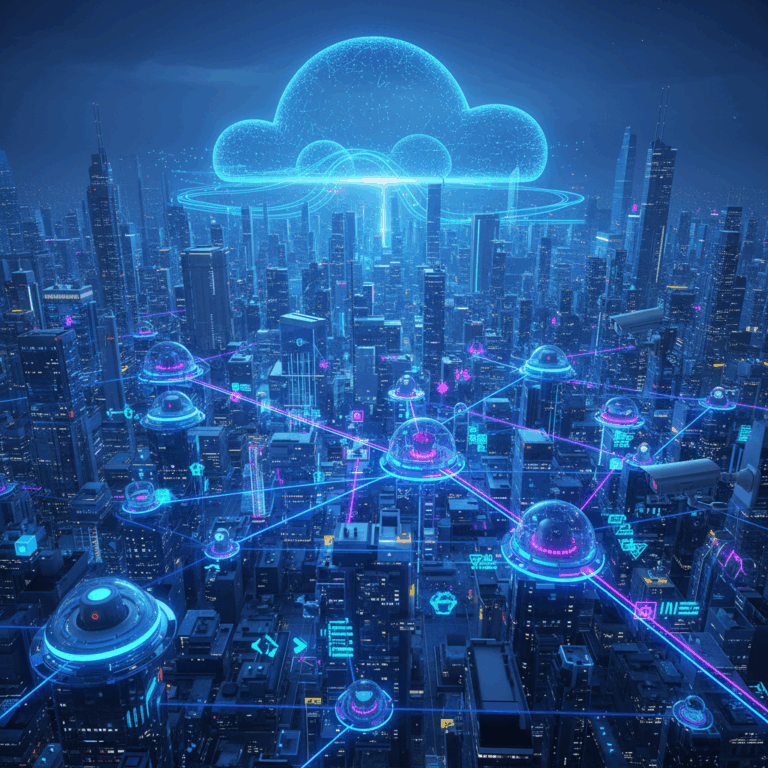
Fundamentals of Decentralized Edge Computing
Decentralized edge computing shifts data processing from centralized servers to local devices at the network edge where data originates. This approach enhances speed and reduces latency by enabling real-time analytics closer to the source.
By processing data locally, edge computing addresses bandwidth limitations and privacy concerns frequently associated with centralized cloud models. It empowers immediate decision-making essential for time-sensitive applications across various industries.
Shift from Centralized to Edge Processing
The transition from centralized cloud processing to edge computing embeds intelligence directly into devices like sensors and smartphones. This decentralization minimizes data transfer needs, cutting costs and improving response times.
Applications requiring instant action, such as autonomous vehicles and healthcare devices, benefit greatly from this shift. Keeping computation local enhances privacy, as sensitive information is less exposed to network vulnerabilities.
Overall, decentralized edge processing redefines data management by empowering devices to analyze and act upon data independently, reducing dependency on distant cloud servers.
Role of Edge AI Processors and 5G Networks
Specialized Edge AI processors enable complex computations directly on edge devices, supporting advanced machine learning tasks without cloud reliance. These processors optimize power consumption and speed for local intelligence.
The widespread deployment of 5G networks further catalyzes edge computing by providing high-speed, low-latency connectivity. This combination allows seamless real-time data exchange and processing at the edge.
Together, Edge AI hardware and 5G create a powerful ecosystem that supports scalable, resilient decentralized solutions, enhancing local data processing capabilities while ensuring continuous connectivity.
Applications and Benefits of Decentralized Edge Processing
Decentralized edge processing empowers applications by enabling data analysis directly at data sources, delivering faster insights and responses. This approach transforms industries by optimizing real-time decisions.
By processing data locally, organizations reduce dependency on centralized systems, which minimizes latency, cuts operational costs, and enhances overall security while maintaining privacy of sensitive information.
Real-Time Data Analysis and Decision Making
Edge computing facilitates instant data processing at the source, crucial for scenarios where split-second decisions matter. This capability supports systems like autonomous vehicles and industrial automation.
Real-time analysis reduces delays caused by sending data to distant clouds, enabling immediate responses that improve safety, efficiency, and user experiences in dynamic environments.
This local decision-making model also supports adaptive systems that learn and adjust on the fly without relying on constant cloud interaction, increasing operational agility.
Cost Reduction and Enhanced Security
Decentralizing processing lowers bandwidth costs by minimizing data transfers to central servers. This efficiency is valuable for businesses managing large volumes of data from distributed sources.
Local data handling improves security by limiting exposure to interceptions during network transmission. Sensitive information stays closer to its origin, reducing vulnerability to cyber threats.
Furthermore, edge computing supports distributed security policies and automated threat detection, strengthening defense across multiple nodes in the ecosystem.
Industry Use Cases: Autonomous Driving and Healthcare
In autonomous driving, edge processing enables vehicles to rapidly analyze surroundings and make critical driving decisions without cloud latency, enhancing safety and reliability.
Healthcare leverages edge computing to monitor patient data in real time, providing timely alerts and personalized care while safeguarding patient privacy through localized processing.
These use cases demonstrate how decentralized edge computing drives innovation by delivering context-aware intelligence where it is most needed, revolutionizing traditional workflows.
Automation and Orchestration in Edge Systems
Automation and orchestration play a crucial role in managing decentralized edge environments effectively. They allow seamless deployment and maintenance of complex applications across distributed edge nodes.
By utilizing modern automation tools, edge systems can achieve cloud-like flexibility and scalability, simplifying operations while ensuring consistent performance and security at scale.
Infrastructure as Code and Container Orchestration
Infrastructure as Code (IaC) automates the provisioning of edge resources, enabling rapid, repeatable deployment of environments across diverse locations. This approach reduces manual errors and accelerates rollouts.
Container orchestration platforms like Kubernetes manage workloads dynamically, optimizing resource usage and facilitating easy updates across thousands of edge devices. They ensure high availability and scalability.
Together, IaC and containers form the backbone of modern edge deployments, providing agility and resilience. They streamline the complexity inherent in managing distributed infrastructures with minimal human intervention.
AI-Driven Monitoring and Self-Managing Systems
AI-driven monitoring continuously analyzes system health and performance at the edge, detecting anomalies and predicting failures before they impact operations. This proactive approach enhances reliability.
Self-managing systems leverage AI to automate maintenance tasks such as scaling, healing, and security enforcement. These capabilities reduce the need for manual oversight, improving operational efficiency.
By embedding intelligence into management processes, edge environments become adaptive and resilient, capable of responding autonomously to changes and threats across distributed networks.
Future Trends and Impact of Edge Computing
The scalability and resilience of decentralized AI are redefining computing landscapes by distributing intelligence across numerous edge devices. This approach ensures continuous operations even with local failures.
As edge AI systems evolve, they become increasingly capable of self-adaptation and fault tolerance, reducing dependency on central servers and enhancing overall network robustness and performance.
Scalability and Resilience of Decentralized AI
Decentralized AI scales by leveraging a vast array of edge nodes, each capable of independent processing and learning. This distributed model allows networks to expand without bottlenecks common in centralized systems.
Resilience is enhanced since edge nodes operate autonomously; disruptions in one area do not cascade to others. Self-healing and AI-driven management further strengthen system reliability in diverse conditions.
Such decentralization democratizes AI, enabling localized innovation and adaptation to changing environments, critical for applications demanding high availability and fault tolerance.
Predictions on Edge Data Processing Adoption
Industry analysts forecast that by 2025, about 75% of enterprise data will be processed at the edge, reflecting a mainstream shift toward decentralized architectures driven by real-time needs.
This rising adoption is fueled by enhanced 5G networks, edge AI processors, and orchestration tools, all contributing to seamless integration and management of edge resources.
Enterprises across sectors will increasingly rely on edge computing to reduce latency, improve security, and enable scalable, responsive applications that meet evolving user expectations.