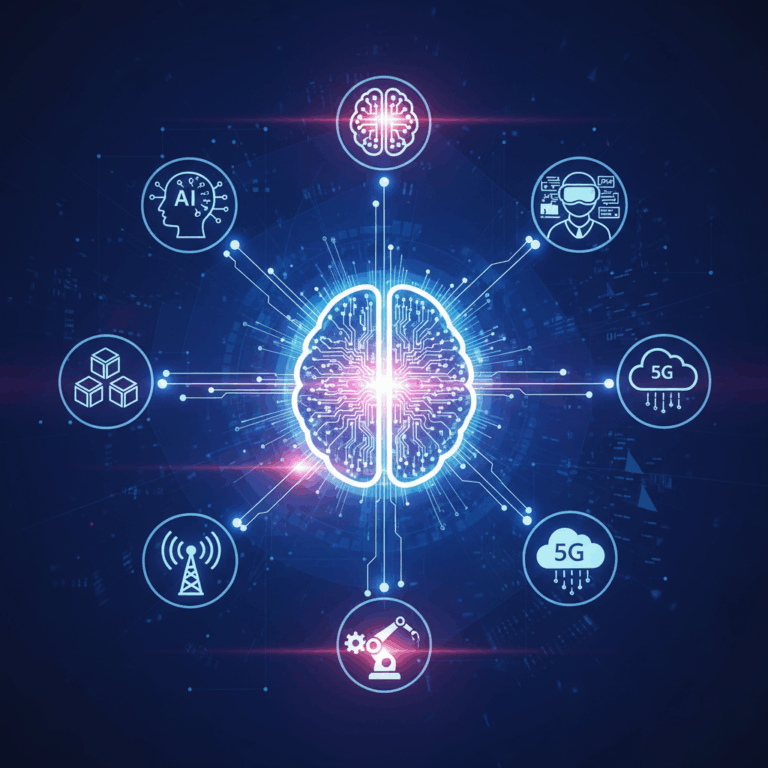
Network Advances Driving the Digital Future
The rapid evolution of network technologies is a cornerstone of the digital future. Innovations like 5G provide ultra-fast data speeds and minimal latency, enabling revolutionary applications across industries.
Coupled with edge computing, these advances improve data processing efficiency by bringing computation closer to devices, critical for real-time decision-making in connected environments.
Together, these network advances support expanding digital ecosystems, fostering smarter cities, automated industries, and seamless user experiences worldwide.
5G Expansion and Its Impact
5G technology delivers data speeds up to 10 times faster than 4G and drastically reduces latency, transforming how devices communicate in real time. This leap supports innovations like autonomous vehicles and augmented reality.
Its expansive coverage and high capacity allow billions of IoT devices to interact seamlessly, facilitating smarter infrastructure and more responsive digital services than ever before.
By enabling immediate data transfer and processing, 5G acts as a critical enabler for emerging applications requiring high reliability and low delay, marking a significant shift in network performance standards.
Role of Edge Computing in IoT
Edge computing processes data near its source, minimizing delays and bandwidth use within IoT systems. This localized data handling is vital for real-time analytics in smart homes, traffic systems, and industrial automation.
By reducing reliance on centralized data centers, edge computing enhances efficiency and resilience of IoT deployments, supporting applications that demand rapid, reliable responses to environmental changes.
Integrating edge computing with IoT accelerates data-driven decisions, improves user experiences, and drives innovation in sectors like agriculture, manufacturing, and urban development.
Immersive Technologies Transforming Experiences
Immersive technologies like Virtual Reality (VR) and Augmented Reality (AR) are revolutionizing how users interact with digital content. These technologies create engaging experiences by blending real and virtual elements.
Advances in hardware and software, alongside AI integration, are enhancing immersion, making these tools applicable across sectors such as gaming, education, healthcare, and industrial operations.
The continuous improvement of immersive tech is driving new ways to visualize data, collaborate remotely, and train professionals more effectively, shaping future digital experiences.
Virtual Reality Advancements
Modern VR technology provides high-resolution displays and responsive tracking, making virtual environments incredibly lifelike. This progress enriches user engagement and expands VR use beyond entertainment.
Innovations include haptic feedback and AI-driven environment adjustments, which create more intuitive and immersive experiences. These features aid training simulations and remote collaboration markedly.
With decreasing hardware costs and improved accessibility, VR applications are growing in fields such as education, medical therapy, and industrial design, transforming traditional workflows.
Applications of Augmented Reality
Augmented Reality overlays digital content onto real-world scenes, allowing users to interact with enhanced information in real time. This capability is transforming retail, maintenance, and education sectors.
AR enhances customer experiences by providing interactive product demonstrations and contextual data, while in industrial contexts, it supports hands-free operation and error reduction.
The technology also fosters innovative learning approaches, enabling immersive education through interactive visualizations that deepen user understanding and engagement.
Integration of AI in Immersive Tech
Artificial Intelligence powers smarter immersive environments by enabling real-time adaptation to user behavior and preferences, improving personalization and interaction quality.
AI algorithms analyze user inputs, predict needs, and optimize virtual environments, enhancing realism and responsiveness across VR and AR applications.
Enhancing Immersion with AI
AI-driven features such as natural language processing and object recognition allow intuitive control and seamless interactions in immersive experiences, elevating usability.
Intelligent Systems and Automation
Intelligent systems are revolutionizing industries by automating complex tasks and enabling smarter decision-making. Automation powered by AI and machine learning improves efficiency and reduces human error.
These technologies facilitate adaptive processes, predictive insights, and autonomous operations in areas like manufacturing, healthcare, and logistics, driving forward digital transformation.
By integrating intelligent automation, organizations can optimize resources, enhance productivity, and innovate faster while maintaining high standards of accuracy and quality.
Artificial Intelligence and Machine Learning
Artificial Intelligence and machine learning empower systems to learn from data, detect patterns, and make predictions without explicit programming. This capability advances personalization, automation, and analytics.
AI applications range from natural language processing, enabling better communication with machines, to intelligent automation that streamlines workflows and supports complex decision-making.
Continuous improvements in algorithms and data availability drive AI’s adoption across sectors such as finance, education, and healthcare, enhancing problem-solving and operational efficiency.
As AI systems evolve, ethical considerations and transparency become critical to ensure responsible deployment and trust in automated processes.
Digital Twins for Simulation and Optimization
Digital twins create digital replicas of physical assets or processes, allowing real-time monitoring and simulation. They help predict performance, test scenarios, and optimize operations without risks.
Industries use digital twins to enhance product design, improve maintenance strategies, and increase system resilience by analyzing behavior under varying conditions virtually.
This technology supports innovation by enabling data-driven insights and enabling rapid adjustments, reducing costs and downtime in manufacturing, urban planning, and energy management.
Supporting Technologies Enhancing Connectivity
Supporting technologies like blockchain and cloud computing are critical pillars enhancing connectivity in the digital era. They strengthen security and scalability across systems.
These innovations complement advances in networks and intelligent systems by providing foundational tools that enable trusted transactions and efficient data handling.
As connectivity expands, such technologies optimize infrastructure, ensuring data integrity and enabling responsive, distributed digital ecosystems worldwide.
Blockchain and Distributed Ledgers
Blockchain technology secures data through decentralized, tamper-resistant ledgers, ensuring trust and transparency in digital transactions. This capability is vital for industries requiring robust authentication.
Distributed ledger systems enable real-time, verifiable record-keeping without relying on centralized authorities, reducing fraud and enhancing auditability across supply chains, finance, and healthcare.
By facilitating smart contracts and secure peer-to-peer exchanges, blockchain fosters innovation in areas like digital identity, asset management, and decentralized finance, revolutionizing traditional models.
Cloud and Edge Computing Innovations
Cloud computing provides scalable, on-demand resources that support vast data storage and complex applications, enabling businesses to operate flexibly and efficiently in the digital landscape.
Complementing cloud, edge computing reduces latency by processing data near its source, critical for real-time applications such as autonomous vehicles, smart cities, and industrial IoT deployments.
Recent innovations focus on hybrid architectures combining cloud and edge, optimizing performance and resource use, and supporting emerging technologies that require fast, reliable connections and data handling.