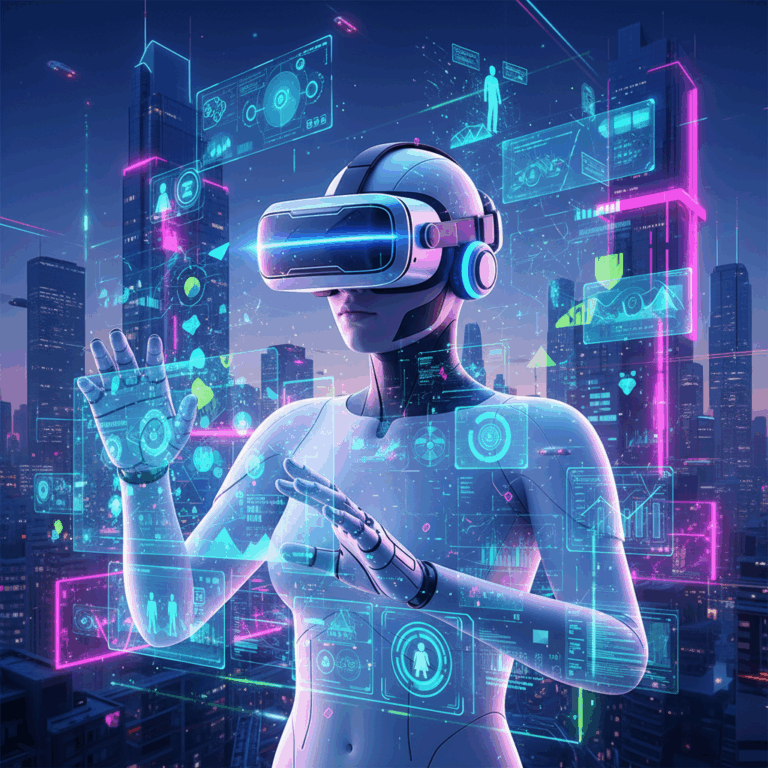
Technological Advances in AR and VR Devices
The rapid evolution of augmented and virtual reality technology is reshaping our interaction with digital and physical worlds. In 2025, innovations in AR glasses and VR headsets are pushing immersive experiences to new heights.
Leading devices like the Apple Vision Pro and Meta Quest series blend digital content seamlessly into real environments. This advancement is making AR more practical and accessible for everyday use.
With a clear focus on sleek, lightweight design, better battery life, and user-friendly interfaces, AR and VR devices are becoming essential tools that integrate smoothly into daily routines and professional tasks.
Next-Generation AR Glasses and Headsets
Next-gen AR glasses and headsets are focused on delivering richer mixed reality experiences. Devices now feature high-resolution displays and advanced sensors to track user movements and surroundings accurately.
These new devices enable a more natural way to interact with digital content by making it appear as part of the real world. This shift allows users to remain engaged with their physical environment while accessing digital information effortlessly.
Manufacturers are also enhancing comfort and battery efficiency to support longer wear times, broadening AR applications beyond entertainment to include productivity, healthcare, and education.
Improved Hardware Design and User Interfaces
Efforts in hardware innovation prioritize reducing device bulk and improving ergonomics, leading to comfortable AR/VR glasses and headsets. This encourages prolonged use without causing fatigue or discomfort.
User interfaces are evolving to be more intuitive, incorporating natural inputs like voice commands, hand gestures, and eye tracking. These improvements simplify interaction and increase immersion.
Moreover, better battery technology extends usage periods, while faster processors and optimized software create smooth and responsive experiences, critical for mainstream adoption of AR and VR devices.
Emerging Mixed Reality Experiences
Mixed reality (MR) merges virtual content with the physical world, allowing users to interact with both simultaneously. This blend enhances immersion, creating new possibilities across applications.
As MR technologies advance, they enable more seamless integration, fostering experiences that are both interactive and context-aware. This revolutionizes gaming, education, and remote collaboration.
Emerging innovations in tracking, haptic feedback, and spatial computing are driving these experiences to become more realistic, intuitive, and engaging for users everywhere.
Integration of Virtual and Real Environments
MR devices use advanced sensors and cameras to map physical spaces in real time. This allows virtual objects to appear anchored in the real world, responding naturally to user movements.
Such integration breaks down barriers between realities, enabling dynamic interactions where digital content coexists and adapts within physical surroundings effortlessly.
Applications now leverage these features for immersive games, design visualization, and interactive training where virtual elements enhance real-world scenarios effectively.
Innovations in Interaction: Tracking and Haptics
Hand and finger tracking technologies enable precise, natural gestures as input, eliminating the need for controllers. This creates more intuitive AR/VR interactions that feel organic.
Haptic feedback gloves and suits provide tactile sensations, enriching user experience by simulating touch and force. They amplify the sense of presence within virtual environments.
Together, tracking and haptics offer users nuanced control and sensory feedback, making mixed reality experiences more immersive and lifelike than ever before.
Interesting Fact: Verifocal Displays
Verifocal displays adjust focus dynamically based on where the user looks, reducing eye strain and improving depth perception in mixed reality setups for a more natural visual experience.
Spatial Computing Applications
Spatial computing enables users to manipulate digital objects as if they exist physically, responding to gestures and positioning with spatial awareness.
This capability is transforming fields like architecture, medical visualization, and collaborative design, where precise 3D interaction is essential for productivity.
By enabling seamless navigation and control in three-dimensional space, spatial computing is a cornerstone technology for the future of AR, VR, and mixed reality experiences.
Role of Artificial Intelligence in AR/VR
Artificial intelligence is transforming AR and VR by making environments more personalized and adaptive. It enhances user experiences by anticipating needs and tailoring content dynamically.
AI integration empowers AR and VR applications to offer real-time insights, smarter interactions, and seamless translation, increasing their effectiveness in various domains.
From gaming to education and healthcare, AI-driven AR/VR is pushing the boundaries of immersive technology, making virtual experiences more responsive and intelligent.
AI-Driven Personalization and Adaptivity
AI enables AR/VR systems to learn user preferences and adjust the experience accordingly, creating highly personalized environments. This adaptivity improves engagement and usability.
By analyzing user behavior and context, AI can predict needs and deliver relevant information or assistance, enhancing both entertainment and professional applications.
Dynamic content adjustment powered by AI ensures that virtual scenarios remain relevant, responsive, and immersive, fostering a deeper connection between users and digital worlds.
Additionally, AI supports natural language understanding and gesture recognition, facilitating smooth interaction without cumbersome controls, raising the ease of use significantly.
Healthcare Applications of AI in AR and VR
In healthcare, AI-powered AR and VR provide immersive training environments, allowing practitioners to practice complex procedures safely and effectively.
Real-time AI data analysis combined with AR visualization aids surgeons during operations, enhancing precision and reducing risks by displaying critical information contextually.
Moreover, VR therapies supported by AI offer personalized mental health treatments that adapt to patient responses, improving success rates and user comfort.
AI-driven AR/VR tools are also used for patient rehabilitation, where adaptive exercises promote recovery by adjusting difficulty based on real-time performance and progress.
Impact on Industries and Daily Life
The growth of AR and VR technologies is dramatically changing industries and everyday experiences. They offer new ways for consumers to engage, learn, and interact with their environments.
From retail to education, these immersive tools provide innovative solutions, enhancing visualization, improving efficiency, and making content more accessible and engaging for users.
As these technologies become more affordable and widespread, their influence on how we shop, study, and connect daily is set to expand significantly.
AR in Retail and Consumer Visualization
Augmented reality in retail enables customers to visualize products in their homes before purchase. This reduces uncertainty and improves confidence in buying decisions.
By overlaying digital items onto physical spaces via AR glasses or smartphones, consumers can try furniture, clothes, or accessories virtually, leading to enhanced shopping satisfaction.
This approach not only boosts sales but also cuts returns and fosters personalized experiences, helping retailers build stronger relationships with customers.
Immersive Learning and Educational Benefits
Immersive AR and VR learning environments make education more engaging by placing students inside interactive simulations and virtual scenarios.
These technologies facilitate experiential learning, allowing users to explore complex concepts hands-on, improving retention and understanding across subjects.
From virtual labs to historical recreations, AR and VR expand access and offer personalized pacing, making education inclusive and adaptable to diverse learning styles.