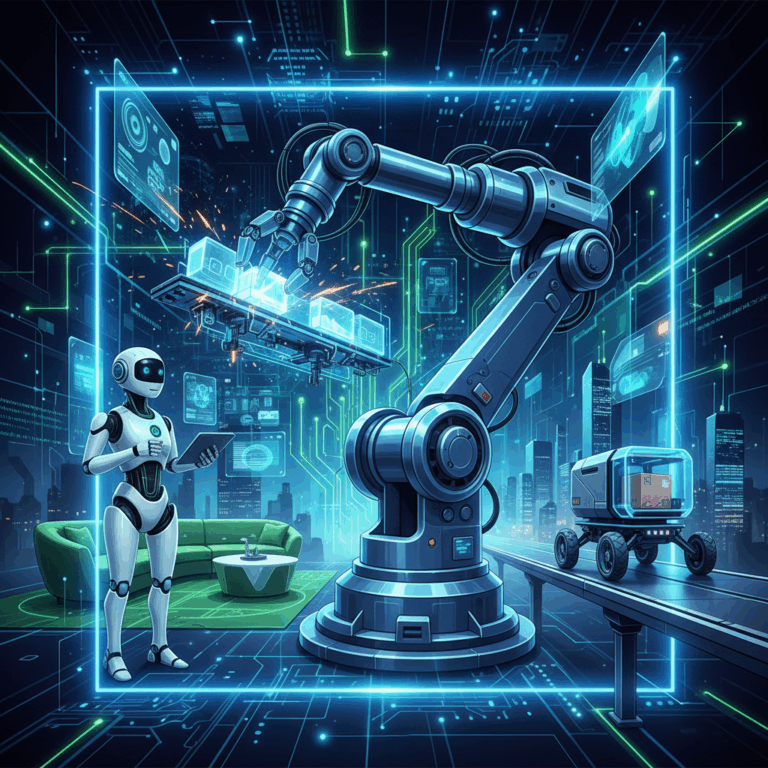
Industrial Robotics Innovations
Industrial robotics is undergoing a significant transformation with the integration of AI and machine learning, enhancing cobots’ capabilities. These advancements allow robots to work closely and safely alongside human operators.
Simplified programming and advanced sensors enable cobots to execute complex tasks autonomously, making them accessible for small and medium enterprises. This fosters improved productivity in various manufacturing environments.
AI and Machine Learning Integration in Cobots
AI and machine learning empower cobots to adapt to dynamic environments and perform tasks with minimal human input. This results in higher flexibility and smarter interactions on factory floors.
With enhanced autonomy, cobots learn from real-time data, improving their performance over time. This capability reduces the need for manual programming and accelerates deployment in diverse industrial settings.
Safety improvements are critical, as cobots can detect and respond to human presence instantly, preventing accidents while maintaining efficient operations. This balance is essential for collaborative workspaces.
IoT-Enabled Predictive Maintenance and Lights-Out Manufacturing
Connecting industrial robots to IoT networks enables predictive maintenance through continuous sensor data analysis. This reduces unexpected downtime and optimizes maintenance scheduling.
Lights-out manufacturing is becoming a reality, where robots autonomously handle production without human supervision. This trend improves efficiency and cuts operational costs, especially for smaller factories.
IoT integration also supports real-time monitoring of robotic systems, facilitating quick response to anomalies and ensuring smoother, uninterrupted manufacturing processes.
Domestic Robotics Developments
Domestic robotics are evolving rapidly, moving well beyond traditional cleaning functions. New robots now offer a variety of household support, including cooking, security, and social companionship.
These advancements are driven by AI enhancements, enabling robots to better understand home environments and carry out complex, interactive tasks. This shift improves convenience and safety in everyday life.
Enhanced Capabilities Beyond Cleaning
Modern domestic robots have expanded their roles to include meal preparation, monitoring home security, and managing household chores with greater autonomy. This versatility meets diverse user needs.
With advanced sensors and AI, robots adapt to dynamic home settings, recognizing objects and surroundings accurately. This progress allows them to perform delicate and precise tasks beyond vacuuming floors.
These capabilities reduce the burden of daily routines, offering more time for homeowners to focus on other activities, leading to a more comfortable living environment.
AI-Driven Interaction and Assistance
AI drives more natural and intuitive interactions between humans and domestic robots, enabling voice commands, gesture recognition, and emotional responsiveness. This enhances usability and engagement.
Robots now assist with reminders, schedule management, and personalized support, acting as smart companions. This assistance fits well with the lifestyle demands of busy households.
By learning individual preferences, AI helps robots customize their responses and actions, making them increasingly helpful and user-friendly over time in home settings.
Robots Improving Home Life Quality
Robots contribute to improving life quality through companionship, helping elderly or disabled individuals with mobility, medication reminders, and emergency alerts, promoting independence.
They also monitor environmental factors like air quality and energy usage, optimizing home comfort and efficiency. These functions help create healthier and safer homes.
Interesting Fact
Research shows that social robots can reduce feelings of loneliness, demonstrating the psychological benefits that these machines bring to domestic settings beyond physical tasks.
Advancements in Autonomous Robots
Autonomous robots have made remarkable progress, especially in sectors like logistics and healthcare. These robots use advanced AI to perform tasks independently, improving operational efficiency.
The continuous evolution of autonomous mobile robots (AMRs) allows for dynamic adaptation to complex environments, ensuring safe and effective interaction with humans and other machinery.
Autonomous Mobile Robots in Logistics and Healthcare
AMRs navigate warehouses and healthcare facilities with precision, automating inventory transport and supporting patient care activities. This reduces human labor and errors.
In logistics, AMRs increase throughput by optimizing routes and schedules autonomously, while in healthcare, robots assist in surgeries and rehabilitation, enhancing treatment outcomes.
These robots employ sensors and AI to detect obstacles and adjust movements instantly, ensuring safe collaboration with staff and patients in sensitive environments.
AI-Driven Real-Time Decision Making
Real-time AI decision-making empowers autonomous robots to respond swiftly to changing conditions, optimizing task execution without human intervention.
This capability enables robots to predict potential faults, adapt operational strategies, and enhance performance, making systems more resilient and efficient.
By processing continuous data streams, AI systems allow robots to self-learn and improve, fostering smarter autonomy that benefits various industrial and medical applications.
Impact and Future Trends in Robotics
The convergence of AI, IoT, and robotics is driving the next wave of transformation, creating smarter, more connected systems. This fusion allows for greater synergy across industries.
As robotics evolve, they become increasingly efficient, safe, and accessible, enabling broader adoption from industrial to domestic applications, shaping the future of automation.
Convergence of AI, IoT, and Robotics
The integration of AI and IoT with robotics allows machines to analyze vast amounts of data and make real-time decisions. This synergy enhances autonomy and responsiveness.
IoT sensors feed continuous data streams to AI algorithms, empowering robots to predict failures, optimize tasks, and adapt to changing environments without human intervention.
This convergence also supports cloud robotics, where robots share knowledge and collectively improve performance, creating decentralized yet intelligent systems for diverse tasks.
Increasing Efficiency, Safety, and Accessibility
Future robotics technologies prioritize improving operational efficiency by reducing downtime and enhancing precision in workflows across sectors like manufacturing, healthcare, and logistics.
Safety is a core focus, with advanced sensors and AI systems enabling robots to detect hazards and humans instantaneously, minimizing accidents and ensuring secure interaction.
Moreover, advancements are lowering entry barriers, making robotic solutions more affordable and user-friendly, which expands accessibility for small businesses and everyday consumers.