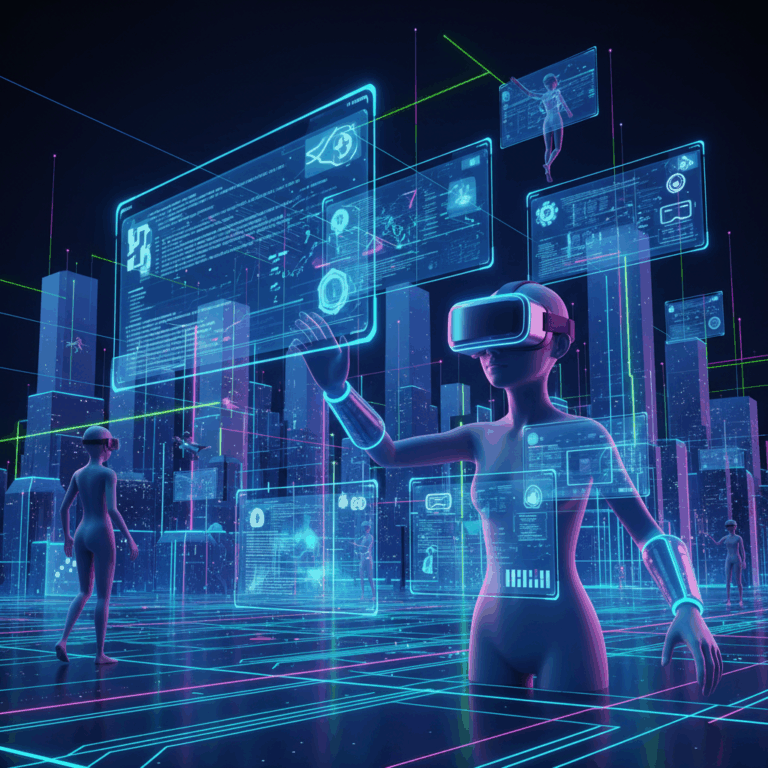
Key Companies Driving Metaverse Hardware Innovation
The metaverse’s growth depends heavily on cutting-edge hardware, with leading companies pushing boundaries to enhance immersive experiences. Innovations in VR and AR devices are central to this evolution.
Meta and Apple stand out as pioneers, investing substantially in next-generation headsets and smart glasses. Their work is critical in shaping user interaction within virtual and augmented environments.
Meta’s Reality Labs and Next-Gen Devices
Meta’s Reality Labs is at the forefront of metaverse hardware innovation, developing advanced VR headsets and smart glasses. Despite financial losses, the lab remains committed to pushing technology further.
Their new devices focus on improving comfort, visual fidelity, and interactivity, aiming to create seamless connections between users and immersive digital spaces. These efforts set standards for others in the industry.
Reality Labs integrates cutting-edge sensors and AI to enable more natural user experiences. Their progress in hardware supports Meta’s broader vision of a fully interconnected metaverse environment.
Apple’s Vision Pro and Lightweight Headsets
Apple’s Vision Pro marks a significant step in sleek, powerful metaverse hardware, combining high-resolution displays with intuitive controls. It targets immersive AR and VR experiences with a premium feel.
Rumors of lighter, more portable headsets suggest Apple’s strategy to broaden accessibility and comfort. This approach aligns with trends toward less bulky devices, making extended use easier for users.
By focusing on design and user experience, Apple aims to attract diverse audiences. Their hardware innovations blend sophistication with usability to elevate metaverse engagement and adoption.
Advancements in Virtual Worlds and Platforms
The development of virtual worlds is accelerating, enabling more immersive and collaborative digital spaces. Platforms now support diverse activities from socializing to work and entertainment.
Advancements are driven by powerful engines and collaborative frameworks that promote real-time interaction and user-generated content, enhancing shared experiences across global users.
These platforms integrate VR, AR, and mixed reality to create persistent 3D environments, building the foundation for the metaverse as a dynamic, interactive ecosystem.
Collaborative Features of Microsoft Mesh and Nvidia Omniverse
Microsoft Mesh enables seamless collaboration by allowing users to meet in shared virtual spaces using holograms and avatars. It supports cross-device communication for broad accessibility.
Nvidia Omniverse focuses on real-time 3D simulation and design collaboration, empowering creators to work synchronously on complex projects with photorealistic rendering and physics.
Both platforms foster creativity and productivity, breaking geographical barriers and enhancing how teams interact within immersive environments worldwide.
Real-Time Interaction on Facebook Horizon Workrooms
Facebook Horizon Workrooms offers a VR workspace where participants interact naturally through avatars, sharing ideas in real-time as if in a physical meeting room.
This platform integrates spatial audio and collaborative tools, boosting engagement and bridging remote communication gaps within the metaverse.
Workrooms exemplifies how virtual environments can revolutionize work by merging social connection with immersive digital settings.
Epic Games’ Unreal Engine Contributions
Epic Games’ Unreal Engine provides powerful graphics and physics capabilities, enabling developers to create lifelike virtual worlds with high fidelity and responsiveness.
Its open platform encourages extensive user-generated content, fueling creativity and expanding the metaverse ecosystem through moddable, interactive experiences.
Unreal Engine’s continued evolution supports cross-platform development, making it a cornerstone technology in building immersive metaverse applications.
Augmented Reality’s Role in Metaverse Growth
Augmented reality (AR) is crucial to metaverse expansion by blending digital layers onto the physical world. This integration enhances user interaction without requiring fully immersive VR gear.
AR’s accessibility on everyday devices allows a wider audience to experience metaverse elements. Its real-time digital overlays enrich activities from gaming to education, broadening metaverse appeal.
AR Accessibility on Smartphones and Devices
AR is highly accessible through smartphones and tablets, which are equipped with cameras and sensors capable of overlaying digital content on real environments.
This device compatibility lowers barriers for users, enabling them to engage with AR experiences without purchasing specialized headsets or glasses.
Popular AR applications include navigation aids, interactive games, and social media filters, all contributing to growing familiarity and use of metaverse components.
Differences Between AR and VR Adoption
Unlike VR, which requires bulky headsets and often isolates users, AR offers a more seamless way to interact with digital content while staying aware of the physical world.
AR adoption is thus faster and broader because it leverages devices people already own, making it a key driver for early metaverse engagement and growth.
VR’s fully immersive focus targets niche applications and enthusiasts, while AR’s convenience supports mass-market expansion across diverse demographics.
Supporting Technologies and Business Impact
The metaverse’s growth relies on integral technologies like blockchain, 5G, edge computing, and IoT. These innovations enable secure asset ownership, fast data flow, and real-time responsiveness within virtual environments.
Together, they enhance user immersion by ensuring connectivity and interactivity are seamless, allowing the metaverse to blend digital and physical realities more effectively.
Blockchain, 5G, Edge Computing, and IoT Integration
Blockchain secures digital asset ownership via NFTs, creating trust and rarity in virtual goods and environments. This underpins economic interactions within the metaverse.
5G networks provide high-speed, low-latency connections essential for real-time metaverse experiences, supporting smooth interactions without delays or disruptions.
Edge computing reduces data processing latency by handling computations closer to users, improving responsiveness in AR and VR applications across large, distributed spaces.
IoT integration connects physical devices and data streams to the metaverse, enriching virtual worlds with real-time environmental inputs and enhancing immersive experiences.
Metaverse as a New Frontier for Commerce and Social Engagement
The metaverse offers businesses innovative spaces for virtual stores, events, and interactive marketing, fostering new commerce models that blend digital and physical purchases.
Social engagement flourishes as users participate in shared digital experiences, creating communities and networks beyond geographical constraints in dynamic 3D environments.
This emerging digital frontier is projected to grow rapidly, presenting significant opportunities while challenging companies to address privacy, regulation, and seamless integration.